
Evidence and reconstruction above existing GRC

Decisions you can prove. Years later.

Dossier Secure Enterprise is the evidence and reconstruction layer above the systems you already use. It preserves the decision route: what the board knew, decided and relied on, tied to the versioned rule that applied at that time.

If you can’t prove it, you can’t defend it.

A Dossier Secure evidence library with governance records, controls and reconstructionEen Dossier Secure bewijsbibliotheek met governancestukken, controls en reconstructie
The work behind a reviewable decision

Where the evidence earns its value

Three moments where evidence must hold.

Reconstruction, pre-submission validation and incident reporting determine whether a record can carry a decision when scrutiny arrives. In the Netherlands, the Cybersecurity Act has applied since 15 August 2026 to more than 8,000 organisations.

01The decisive proof

Forensic reconstruction

Rebuild the decision. Not the story around it.

The historic rule, event, authority and recorded outcome are replayed together. Each verdict is append-only, separately hashed and RFC 3161-timestamped; an earlier verdict remains intact.

Byte-for-byteverdict with reasonSeparately sealedhash and timestamp

PASSED means replaymatch: the stored and replayed outcomes match. It is not legal approval.
02Before submission

DORA Register of Information

Find register failures before submission.

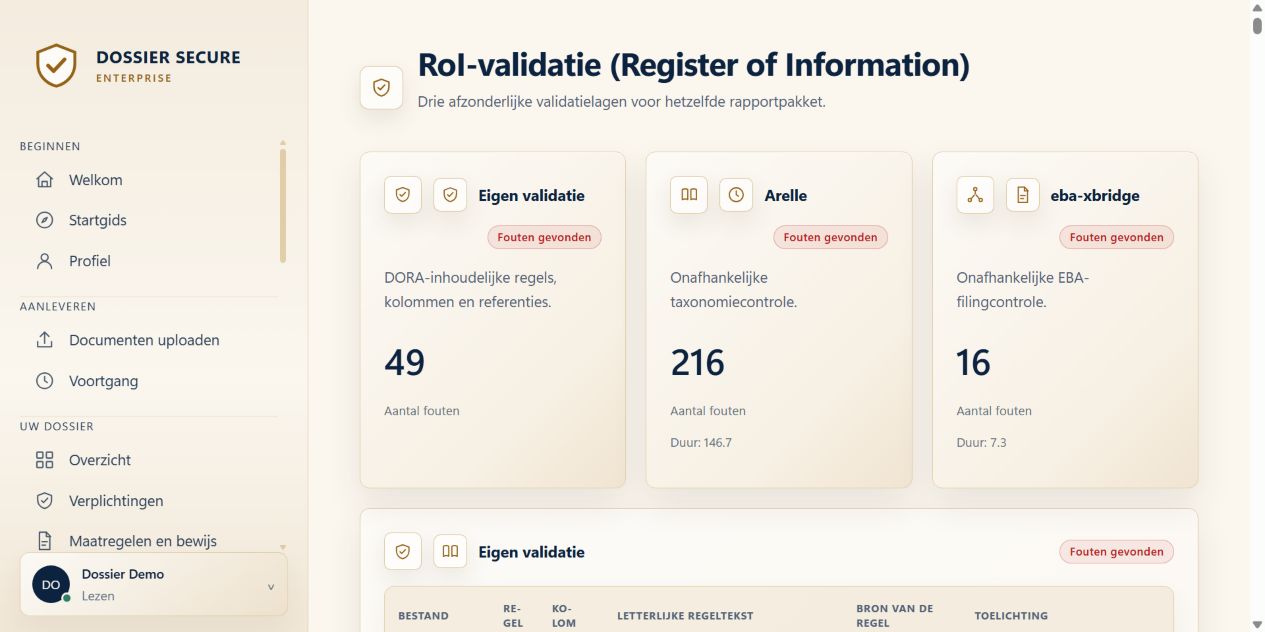
The official 120-rule registry is structured across technical, DPM technical, DPM business and LEI/EUID layers. Nineteen rules are mechanically executed today; every remaining rule is explicitly marked, never assumed passed.

6.5%of 947 information registers passed all 116 data-quality checks in the ESAs' 2024 dry run.
Source: ESAs dry run, 17 December 2024
03Under time pressure

Incident reporting

Defend every report under pressure.

Classification, evidence and the filed report stay together while the product shows the three DORA clocks separately. What happened and what was reported remain reviewable afterwards.

4hinitial72hintermediate1 monthfinal

One reviewable chain

Five linked proof layers. One defensible decision.

Every layer answers a different reviewer question. Together they preserve the route from the rule that applied to the verdict a reviewer can independently inspect.

  1. 01LawWhich rule applied?
    Verbatim source textVersion and validityProvision-level hash
  2. 02ObligationWhy did it apply here?
    Entity applicabilityTraceable derivationCurrent or excluded
  3. 03ControlWho had to act?
    Measure and ownerTest and findingRemediation remains linked
  4. 04EvidenceWhat proves the action?
    Supporting artefactAuthority and contextHash and timestamp
  5. 05ReconstructionCan the outcome be relived?
    Historical rule and eventByte-for-byte verdictExternally verifiable seal

A missing link is not hidden or inferred. It remains visible until the record can support it.

The questions that change a review

Nine questions. One uninterrupted record.

The point is not to make uncertainty disappear. The point is to make it inspectable.

  1. 01Can a reviewer reconstruct the decision?
  2. 02Which legal version applied?
  3. 03Who held authority at that moment?
  4. 04What information was actually available?
  5. 05Which obligations apply to this entity?
  6. 06Where is the supporting evidence?
  7. 07What did the independent checks find?
  8. 08When was the record anchored?
  9. 09Can the outcome be replayed?

Proof in the product

The evidence chain is not a presentation. It is the working surface.

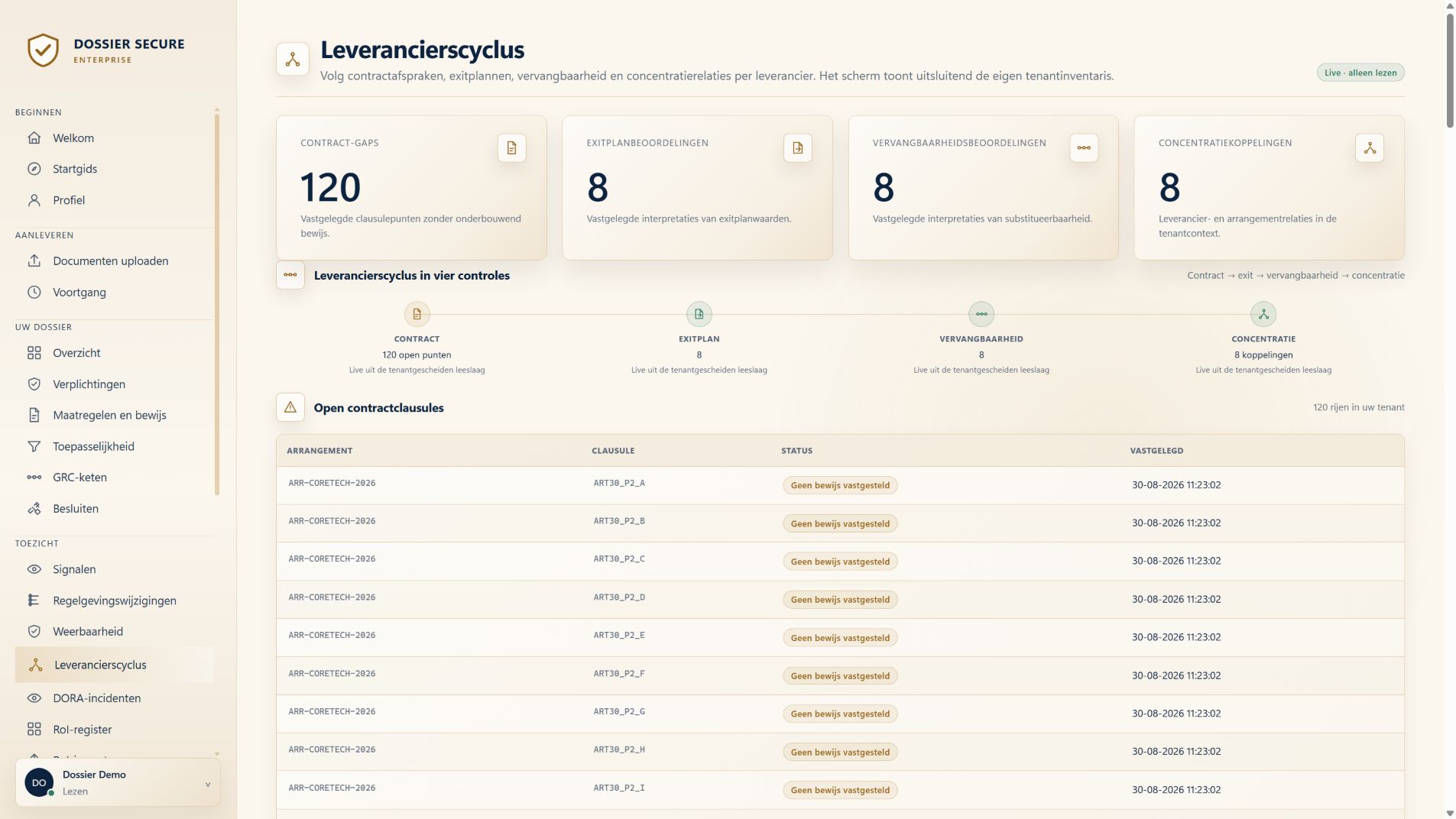
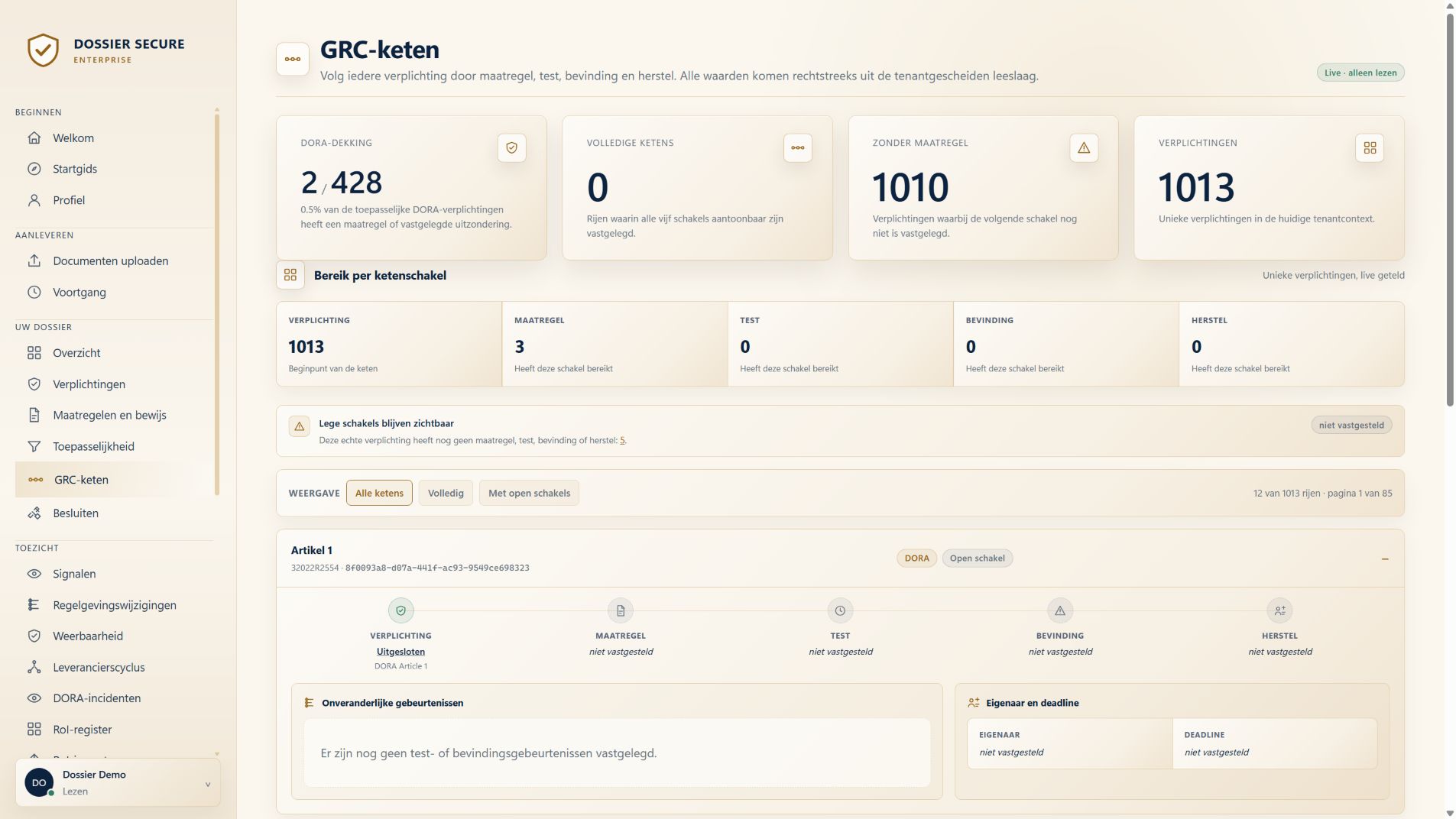
These anonymised live screens show the working record: rule, obligation, control, evidence and reconstruction. No simulated interface.

Dossier Secure Enterprise workspace with the product visible on a laptopDossier Secure Enterprise-werkplek met het product zichtbaar op een laptop

Evidence at work

Evidence should be ready before the review begins.

The product keeps operational context close to the decision. It remains visible, structured and ready to inspect.

What the record says

A confidence signal is not proof. The trail is.

ConnectedRule, authority, measure and evidence remain linked for review.

Visible gapA missing element stays visible; it is not treated as resolved.

ReplaymatchPASSED means the stored and replayed outcomes match, not legal approval.

The enterprise distinction

Keep the operational system. Add a decision trail that can be reconstructed.

Operational systems retain documents and workflows. Dossier Secure Enterprise links the historic rule, authority, evidence and recorded outcome, so a later review begins with a reproducible route rather than a manual reconstruction.

Enterprise questionEvidence and reconstruction layerConventional operational record
Primary jobProve a past decision and its contextManage current workflows and control status
Time contextVersioned rule, authority and information remain linkedThe current view may be primary
ReconstructionControlled replay with a separate sealed verdictMay require manual collection and interpretation
Missing proofRemains explicitly not establishedA completed workflow does not necessarily prove the historic chain

ROI calculator

Make your own assumptions visible.

A planning aid, not a claim: estimate reviews × hours × internal hourly rate.

€0Illustrative input only; it is not a promise of savings.

Live jurisdictions

NL and BE are live. Each tenant remains separate.

Operating boundary

Country and supervisor stay explicit.

Choose Netherlands, Belgium · NBB or Belgium · FSMA. Each legal entity or business division has an isolated tenant; its data is not visible to another tenant. Dutch, English, French and German are supported. Expansion to the UK, Ireland, Canada, Australia and the United States is in preparation.

Read the Trust page

The operating model

Your institution enters its facts. Dossier Secure Enterprise builds the evidence case.

The live foundation connects versioned legal sources, obligation routes, controls and evidence; exposes implemented register checks and incident clocks; and replays recorded outcomes. No AI takes part in derivation, weighting or execution: an outcome that cannot be reproduced proves nothing later. End-to-end automation is presented only where it is proven.

LIVE = proven in the productDIRECTION = target operating model
  1. 01
    Institution · Direction

    Enter the facts

    ICT providers, contracts, functions, assessments and the organisational profile become the institution’s factual input.

  2. 02
    SaaS · Proven where mechanised

    Route what applies

    Applicable obligations are derived from versioned sources where the mechanism is live; every unsupported link remains explicit.

  3. 03
    SaaS · Live scope

    Validate before submission

    Nineteen of the 120 registered RoI rules execute mechanically today. All remaining rules stay visibly unexecuted, never assumed passed.

  4. 04
    SaaS · Live modules

    Keep the review context

    Incident clocks, validation findings, ownership and remediation remain connected in the reviewable record.

  5. 05
    SaaS · Live reconstruction

    Replay against the moment

    The recorded outcome can be replayed against the policy and authority of that moment, then stored in a separate hashed, RFC 3161-timestamped verdict. The timestamp is not qualified under eIDAS until a QTSP upgrade.

Private proposal

Start with the decision that must withstand scrutiny.

Before a commercial proposal, one consequential decision is reviewed for traceability, missing context and reconstruction. The next scope follows privately from what the record can and cannot support.

Define the evidence scope

FAQ

The questions that decide whether evidence holds.

Can we reconstruct what was known when the decision was made?

The evidence route keeps the source version, authority, decision, controls and supporting records connected for review.

What remains visible when supporting evidence is missing?

The gap remains reviewable until it is addressed; it is not presented as resolved or compliant.

Can we trace a rule all the way to the evidence?

The GRC route connects source, obligation, control, evidence and reconstruction as one inspectable chain.

What does a PASSED replay actually prove?

It means stored and replayed outcomes match: replaymatch, not legal approval.

Do we need to begin with a full enterprise rollout?

No. The implementation route starts with one consequential decision and its records; the next scope follows after that route is reviewable.

What can procurement verify before a proposal?

The Trust page separates technical product evidence, partial implementation evidence and items that are still unestablished or on the roadmap.

A confidential first review

Request a private evidence review.

We review which rule applied, who held authority, what information was available, what evidence is missing and whether the recorded outcome can be reconstructed. You receive a clear scope for the next step. It is not a public assessment.

Request a private evidence review